Help by Sharing Your Knowledge

Information ► Knowledge ► Capacity / Мэдээлэл ► Мэдлэг ► Чадавхи;
Showing posts with label Disability/Ability - Mongolia. Show all posts

Thursday, April 18, 2013

Хөгжил...


Саяхан би Цюрихийн ХБИ-ийн нэгэн ТББ-ын хүнтэй  уулзаж байхдаа “Танай байгууллага одоо ямар асуудал дээр ажиллаж байна?” гэж асуулаа. Хариуд, манай үндэсний Төмөр Замын Сүлжээ компани энэ жил 20 орчим галт шинээр тэрэг хийж байгаа. Тиймээс бид түүнийг хийж байх үеэс нь хүртээмжтэй болгохын төлөө энэ компанитай хамтран ажиллаж байгаа гэхэд нь би их гайхсан. 

Танай вагонууд чинь хангалттай хүртээмжтэй биш үү \хүртээмжийн нь талаар оруулсан зурагнууд энд байгаа: http://oidov.blogspot.ch/2012/07/blog-post.html \. Ямар ч төрлийн бэрхшээлтэй, бэрхшээлгүй хүмүүс  чөлөөтэй орж гардаг гэхэд. Тиймээ, гэвч бид зөвхөн орж зорчдог төдийгүй ресторан, тоглоомын газраар нь үйлчлүүлдэг болмоор байна, бидний тэрэг багтадаггүй юм гэж хэлсэн.

Харин Монголд бид дотор нь явж үйлчлүүлэх байтугай, орж  ч чададгүй нөхцөлийг бодоод  дотроо хүний хөгжлийн тухай бодон харуусаж  суулаа. Харуусах, болохгүй байгаа юм их л байгаа. Болохгүй байгаа юм болгоныг харааж суух нь гол нь биш байх. Харин шийдлийг олох нь илүү үр дүнтэй.

ХБИ-дэд хүртээмжтэй үйлчилгээ хэрэгтэй, харин бизнесуудад үйлчлүүлэгчид хэрэгтэй. Хэрэв ТББ нь бид энэ хороо\дүүргий.... тооны хүнээр таны үйлчлүүлэгчдийг нэмээд ....  хугацааны туршид танайхаас ийм хэмжээний худалдан авалт хийж байх болно гэсэн тооцоотой очвол хамтран ажиллахад дөхөмтэй байх. Үүний тулд сайн зохион байгуулалт, нөөцийг зөв харах нь л чухал гэж бодогдлоо.         

Friday, April 5, 2013

We demand an equal and a real participation!

Saturday, July 14, 2012

Сонсох ёстой мессэж


Cаяхан нэгэн захидал хүлээж авлаа. Захидлыг нэг уншчихаад дахин хоёр ч удаа давтан уншлаа. Яагаад гэвэл энэ захидалд Монголын ХБИ-д, ТББ-ууд тэр дундаа Монголын Сонсголын Бэрхшээлтэй Хүмүүсийн амьдралын олон талыг, туулах ёстой болдог замыг их тодорхой дүрсэлсэн байхыг олж харсан юм. Олон Улсад Монголын ХБИ-ийн амьдралыг танилцуулах үүднээс захидлыг Англи хэл дээр хөрвүүлэн тавих бодол байгаа ба энэхүү захидлыг бичсэн эзнээс нь зөвшөөрөл аван уншигч та бүгдэд энэ захидлыг толилуулж байна. 


"Сайн байна уу? 

Сонсголын бэрхшээлтэй иргэдийн төлөөлөл болохын хувьд өөрийн тухай товчхон бичье, бүх иргэдийг төлөөлж ярих гэвэл хэцүү л дээ. Сонсгол хэл ярианы бэрхшээлтэй иргэдийн хувьд боловсролын асуудал нилээн хэцүү талдаа байна. Миний хувьд 10 жилийн боловсролоо аав ээж, ах эгчийнхээ тусламжтайгаар өөрөө бие дааж эзэмшсэн гэхэд болно. Монголд ганц 29 гээд дүлий хүүхдэд зориулсан сургууль байдаг, албан ёсоор улсаас бүх дүлий хүүхдийг тэнд сургах шийдвэр гаргаж, тушаалаар суралцуулдаг байлаа. Гэхдээ ээж аав маань 29-ийн багш нартай уулзсны дараа гэртээ байлгахаар болсон. Нэг багш нь 29-д хүүхдээ сургаад бүр хэн ч биш болгоод эвдэж хаяад, сүүлдээ авахад хэцүү, хаяхад хэцүү дараатай л хүн болно доо гэсэн утгатай юм хэлсэн юм билээ.

Нэгэнт сургуульд сургахад хүндрэлтэй болохоор гэртээ дөрвөн аргын тоо болон бусад зүйл зааж өгч байсан, ерөнхийдөө би өөрөө л хүссэн зүйлсээ сурсан л даа. Гэхдээ Хими, Физик гэх мэт нарийн мэргэжлийн хичээлүүдийг бол шууд хаясан. Тэгээд Албан бус боловсролын програмаар 10 төгсөх гэрчилгээний шалгалт өгч гэрчилгээгээ авч байлаа. Тэр гэрчилгээтэй болсноор цааш их, дээд сургуульд элсэхэд амар болсон. Өөрийгөө гэрийн боловсролтой гэж маш их голдог байлаа, гэтэл олон жилийн дараа 29 төгссөн хүүхдүүдтэй танилцаж, хамт ажиллаж эхлээд үнэндээ гайхсан шүү. Тэд нар 10 жил 29-т сурсан хэдий ч бичиг үсгийн чадвар маш муу, зарим нь бичиг үсэгт тайлагдаагүй шахам байсан. Хамгийн хэцүү нь тэд ерөнхийдөө зөвхөн өөрсдийн хүрээнд, өөрсдийн соёлоор харьцдаг, олон нийтийн болоод эрүүл хүмүүсийн соёлоос үнэдээ тасархай, харь байдаг нь байсан. Хэлгүй, дүлий хүн бичгийн чадвар муутай байдаг гэж дэлхий даяар ерөнхийдөө мэдэж болох ч монголд сул сонсголтой хүмүүс нь ялгаагүй дүлий сургуулиар яваад соёлын хязгаарлалтанд ороод тийм сонин болчихсон байдаг юм билээ.

Их дээд сургуульд Баклаварт 4 жил, Мастерт бараг 2 жил нийт 6 жил сурахдаа орчуулагчтай байж үзээгүй ээ. Би өөрөө муу хэдий ч бага сага ярьдаг болохоор багш нараасаа асуух юмаа асууж, хариугаа бичүүлж аваад гардаг, ангийхаа хүүхдүүдийн хажууд сууж лекцээ бичиж авдаг, тэгээд бүх юмаа бие дааж номноос сурдаг байсан. Хааяа их бухимддаг, хувиасаа мөнгөө төлж сурч байгаа хир нь багш нараараа юу ч заалгаж чадалгүй бүгдийг бие дааж сураад явдагтаа уур хүрдэг байсан. Ангийхан маань багшийн жишээ, амьдралтай холбож ярьж байгаа хөгтэй явдал, ангийн оюутнуудын санаа оноо, асуулт зэргийг бичиж авдаггүй, бичүүлэх гэхээр уцаарлаад хичээл биш гээд өнгөрдөг байсан болохоор зөвхөн номноос уншиж, тэрийгээ лекцтэйгээ тулгах, өөрөө ном, сурах бичиг хайж олох гэх мэтээр л явж сурсан. Угаас Монгол багш нар оюутантайгаа тулж ажилладаггүй учраас энийг хангалттай гэж дүгнэдэг байсан байх.

Ерөнхийдөө сонсголын бэрхшээлтэй байх нь олон юмнаас хоцорох, мултарч үлдэх шалтгаан болдог. Өөрийгөө аль болох дайчилж амьдардаг ч заримдаа залхнаа. Шинэ хүнтэй уулзах, танилцах, хамтарч ажиллах болгондоо бүх намтар түүх, яагаад дүлий болсон, яагаад ийм байдлаар амьдарч байгаа, надтай яаж харьцвал ойлголцох боломжтой зэргийг тайлбарласаар сүүлдээ өөрөө мэдэхгүй шантардаг болчихдог юм байна. Манай Монголчууд яг одоогийн өмнө нь зогсож байгаа энэ хувь хүн нь ямар чадвартай, ямар хүн бэ гэдгээс илүү яагаад хөгжлийн бэрхшээлтэй байгаа юм, шалтгаан нь юу юм, тэгээд яаж эрүүл болом юм гээд л бидний ярих дургүй, өөрчилж болохгүй тэр асуудлыг л залхтал асуудаг.

Нийгэмд ХБ-д зориулсан шинэ боломж гарлаа, өөрчлөлт гарлаа гэдэг ч тэр нь дүлий, хэлгүй, сонголын бэрхшээлтэй хүмүүст хамаагүй байдлаар явж байна. Монголд мэргэжлийн сургуулиар бэлтгэгдсэн орчуулагч байдаггүй, мэргэшсэн, сүмд дүлий хүмүүстэй явж байгаад дохио сурсан гэх мэт орчуулагч нар байдаг, эсвэл сул сонсголтой хүмүүс өөрсдөө орчуулагч хийдэг юм. Гэхдээ маш цөөн яаж ч цуглуулаад 10 хүрэхгүй байгаа байх. Одоо энэ сонгуулиар жишээ аваад ярихад би санал өгөхгүй юм шиг байна. Хөдөөний паспорттой, хотод түр амьдарч байгаа энэ сонгуулийн нутаг дэвгэртээ санал өгөх гэхээр дүлий учраас өчнөөн тайлбар тавьж, ойлгуулах гэж махаа идэх байх, мөн ямар аргаар яаж сонууль өгөхийг сайн мэдэхгүй байгаа гээд тээршаагаад сууж байна.

Монголд ХБ иргэд хөгжиж байгаа гэдэг ч харахад дандаа тулах хөдлөх хөдөлгөөний бэрхшээлтэй, тэргэнцэртэй, хараагүй иргэд байна. Дүлий иргэд үнэндээ орхигдож байна шүү. Ганц нэг хүн сургууль төгссөн, сургуульд элссэнийг амжилт, үсрэлт гэж дүгнэж болохгүй байх. Тэр хүмүүсээр жишээ авахаас бус өөр бусад хэрэгтэй юм одоогоор гараагүй байх шив дээ.

Гадагш сурах тухайд гэвэл Монголын дүлий хүмүүсээс нутагтаа TOEFL, IELTS өгөөд сургуульд шалгарсан хүн үнэндээ байдаггүй штэ. Галладуетийг өмнө нь нэг ах төгссөн, одоо нэг охин сурч байгаа. Энэ хүмүүс 2-3 жил тэндээ тэтгэлэгээр англи хэл сурч байж цааш магистрын түвшний сургалтанд орсон хүмүүс байдаг юм. Өөр хэд хэдэн дүлий залуус англи хэлний сургуульд нь элссэн ч хувиасаа төлбөрөө төлж дийлэхгүй гарсан юм билээ.
Монголд англи хэлний сургалтын төвүүд дүлий хүнийг бараг авдаггүй, авлаа гэхэд багш нар нь харьцаж, зааж чадахгүй, дохио мэддэггүй учраас бас л биеэ даагаад сурах болдог. Тэгээд олон улсын стандартад тэнцсэн шалгалтыг нь өгье гэхээр бас шалгалта авах газар олддоггүй юм билээ.

Дүлий иргэдийн нийгэмлэгийн хувьд дүлий хүмүүс ерөөсөө нэгдэж чадахгүй байна. Дүлий хүмүүсийн чиглэлээр үйл ажиллагаа явуулдаг 44 ТББ байгаа. Гэхдээ дарга нар нь хоорондоо таарамж муутай, ихэнхи ТББ нь бусдыг дагаж байгуулсан ч ур чадвар хүрэхгүй, үйл ажиллагаагаа явуулж чадахгүй болоод ажилладаггүй юм шиг билээ. 

Дэлхийн дүлий иргэдийн холбооны гишүүн Монголын Дүлий Иргэдийн Нийгэмлэг гэж байгаа. Гэвч даргых нь эрх аль 2007 онд дууссан, хэсэг дүлий хүн нэгдэж хурал зарлаад 2007 онд өөр хүнийг даргаар сонгосон ч хуучин дарга нь тамга тэмдгээ өгөхгүй зугтаагаад өнөөг хүрсэн. Одоог хүртэл өөрийгөө дарга гээд гадаадад хурал зөвөлгөөнд явсаар байгаа. Харин дотооддоо юу ч хийдэггүй. Даргаа солих гээд ядчихсан, дарга нь заавал таг дүлий, хэлгүй хүнд л тамгаа өгнө гэж зүтгээд бас сүүлдээ дүлий хүмүүс өөрсдөө дүлий, сул сонсголтой хүмүүс тусдаа байх нь зөв, хоёр тусдаа холбоо байгуулвал зөв гэсэн юм ярьж гарч ирээд асуудал үүсээд байгаа юм билээ.
Таныг сурах боломжийн талаар асуусан болохоор өөр дээрээ жишээ аваад сонсголын бэрхшээлтэй, хэлгүй дүлий хүмүүс яаж амьдарч, сурч байгаа талаар нуршуу юм бичлээ. Дүлий хүмүүсийн байдлыг ойлгоход бага болов ч тус болно гэж бодож байна.

Уншсанд баярлалаа.

Хүндэтгэсэн,

Sunday, May 6, 2012

Inaccessible Mongolia/Хүртээмжгүй Монгол


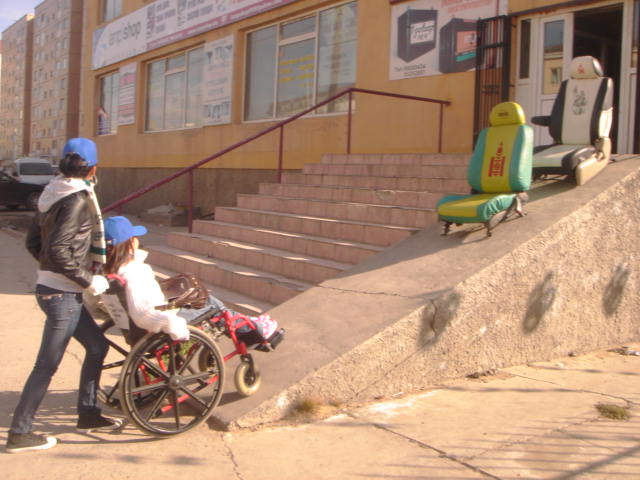
Today I am posting some pictures of ramps built improperly in Mongolia. Those are just few of many ramps built in Mongolia without knowing the real needs of People with Disabilities. It is not enough just to built ramps. Main thing is it has to be accessible, usable by any PWD without any external support. The consequence of this improper facilities are negative impact on people who are in condition to use them daily. People loose their self confidence and feel as humiliated. PWDs feel themselves as segregated and discriminated.The pictures are collected by members of Disability Community of Mongolia. 
Хөгжлийн Бэрхшээлтэй Иргэдэд зориулж байгуулсан гэх боловч тэдний бодит хэрэгцээг бодолгүй барьсан зарим налуу замуудын зургуудыг тавьж байна. Энэ зурагнууд бол Монголд "буруу" баригдсан олон тооны жишээнүүдийн зөвхөн нэгээхэн хэсэг нь юм. Налуу Замыг зөвхөн байгуулах нь чухал биш. Хамгийн гол нь өөр хэн нэгний тусламжгүйгээр өөрсдөө ашиглаж чадахуйц Хүртээмжтэй байх нь чухал юм. Өдөр тутам эдгээр налуу замуудыг хэрэглэхээс өөр аргагүй байдаг Хөгжлийн Бэрхшээлтэй Иргэдэд энэхүү буруу шийдэл нь маш сөрөг нөлөөтэй байдаг. Энэ нь юуны түрүүнд тусгаарлагдмал, ялгаварлан гадуурхлтыг бий болгодог. Тусгаарлагдсаны улмаас ХБИ-д өөртөө итгэх итгэлээ алдаж, доромжлуулсан мэт сэтгэгдэлтэй үлддэг. Эдгээр зургуудыг Монголын ХБИ-ийн нийгэм, хамт олны гишүүд цуглуулав.  


Sunday, February 12, 2012

Mongolia: Ulaanbaatar Grapples With Challenge of Equal Access for Disabled


Munkhtulga Tseveldorj is successful for a 22 year old. Author of two poetry books, he has a third on the way. He’s a good student in the library management program at the Mongolian Institute of Arts and Culture. And he is one of the very few physically disabled Mongolians working on a university degree.

Though he is "handling classes fine,” attending lectures is a challenge. Tseveldorj was born with cerebral palsy—a condition that renders him unable to control his motor movements. He speaks and walks with great difficulty, but cheerfully declares "there is no limit to inspiration," when asked about living with his condition. In Mongolia, many people with physical disabilities are effectively confined to their homes. Like most developing countries, Mongolia lacks public infrastructure such as ramps. School can be just five steps out of reach for a wheelchair-bound child.

Only a handfull of buildings in Ulaanbaatar are equipped with ramps, says Chuluundolgor Bat of the Mongolian Association of Wheelchair Users. Rendered paraplegic in an accident when she was 16, Bat says the only reason she finished college was thanks to constant family assistance.

"I always had a family member by my side throughout college to carry me [up staircases] to my classes. Not everyone is as fortunate to have supportive families who can afford the time and money," she says.

Mongolia ratified the UN Convention on the Rights of Persons with Disabilities in 2009, scripting several laws on disabled persons’ rights into the constitution, such as inclusive education, access to public transport and the right to employment. But few mechanisms exist to implement or monitor implementation of laws, says Selenge Sambuu, director of the Association of Parents of Disabled Children (APDC), a non-profit that campaigns for legislation to address disabled children’s needs.

"There's nothing happening to properly survey and diagnose children and categorize their disabilities,” she says. “Often it's poorly qualified doctors or even teachers who decide if a child is disabled simply because the child is not doing well at school.” Sambuu tells the story of a village toddler diagnosed with cerebral palsy by local medical workers. When he was 16, a visiting team of German doctors identified him as autistic.
"Improper diagnosis is like closing the door on a child. Early intervention is a must to help these children," she says.

Many children with physical disabilities are not accepted by mainstream schools and often end up segregated in special-needs schools where they are prepared for a life separate from society.
Including disabled children in regular schools provides a motivating environment for disabled children and sensitizes able-bodied children, says Sambuu: "When kids understand disabled people are normal except for an impairment, as adults they won't harbor negative attitudes about disability."
Even worse, most disabled children don’t attend school at all.

According to a 2008 survey by the Ministry of Social Welfare and Labor, only 21 percent of disabled children attend regular schools, while 5.8 percent attend special-needs schools. The rest, the report suggests, simply don’t go to school.

Such segregation often starts a vicious cycle of poverty. The State Social Welfare Office estimates that nearly 80 percent of disabled persons in Mongolia live below the poverty line. With government benefits for disabled persons at 30,000 tugrik (approximately $23) per month and another 30,000 tugrik per quarter to cover medical expenses, most disabled persons are unable to afford the treatment they need, activists say.
Zulaa Batchimeg, whose five-year-old daughter Emuujin was born with hip dysplasia – an abnormal development of the hip joints – has seen doctors’ bills send the family into debt. Batchimeg recently spent over a million tugrik (almost $800) on surgery and medicines, most of it borrowed. Although medical care is technically free in Mongolia, specialized surgery and related costs are extra.

For physically disabled adults, many of whom were denied proper education when they were young, employment prospects are bleak. Only about 2 percent of 69,000 adults with disabilities surveyed by the Independent Trade Union of Disabled Persons of Mongolia, a lobby, have salaried jobs. “And they are usually people with mild to moderate disabilities sustained mainly from injuries or accidents,” as adults, said Enkhbayar Luvsdamba, the union’s director. People with congenital impairments "almost never" secure proper jobs.

This is despite a government decree mandating companies employ one disabled worker for every 25 able-bodied. Failing that, employers are required to pay a fine equaling half the minimum salary (about $54 per month) to the Social Welfare Fund for Disabled persons. But that legislation does little to change attitudes in the workplace.

"Most companies prefer to pay the fine rather than spend more to make arrangements to accommodate disabled persons," said Luvsdamba.

Monday, August 8, 2011

Төрөлт нэмэгдэхийн хэрээр тархины саажилттай хүүхдийн тоо өсөж байна


-Гэтэл өрхийн эмч нарт нярай хүүхдийн мэдрэлийн тогтолцоог хянах мэдлэг байхгүй байна-

СХД-ийн иргэн: Эрүүл мэндийн яамны сайд С.Ламбаа танаа


НҮБ-ын хүүхдийн эрхийн конвенцид "Аль ч улс орон нь, сэтгэцийн болон хөдөлгөөний бэрхшээлтэй хүүхэд өөрийн амьдралдаа сэтгэл хангалуун амьдарч, тэдний нийгэмд эзлэх байр суурийг баталгаажуулж, идэвхжүүлж байх нөхцлийг бүрэн хангахыг хүлээн зөвшөөрөх ёстой"-г заасан байдаг.

Энэ нь хөгжлийн бэрхшээлтэй хүүхдийг нийгмийн амьдралд бүрэн, адил тэгш оролцуулах гэсэн хэрэг юм. Гэтэл манайхан хөгжлийн бэрхшээлтэй иргэдийг хүн гэж харахаа болиод удаж байна. Өрөвдөхөөс хэтрэхгүй байсаар өнөөг хүрсэн энэ хүмүүсийн амьдрал улам бүр төвөгтэй болж байна.

Сүүлийн үед төрөлхийн эмгэг, гажигтай хүүхэд олноор төрөх болсон. Үүнтэй зэрэгцэн өвчлөгсөдийн тоо нь нэмэгдэж буй өвчинд тархины саажилт багтаж байна. Тиймээс үр хүүхдийнхээ эрүүл мэндэд санаа зовж, шөнө бүр нойргүй хонодог олон аав, ээжийг төлөөлөн дараах мэдээллийг танд хүргэж байна.

Хөгжлийн бэрхшээлтэй хүүхдүүдийн талаархи нэгдсэн тоо баримт хэрэгтэй байна 

Өнөөдөр хөгжлийн бэрхшээлтэй хүүхдийн ихэнх буюу 66.4 хувь нь орлогын эх үүсвэргүй өрхөд амьдардаг гэсэн судалгаа гарчээ. Эдгээр хүүхдийг өсгөхөд энгийн хүүхдээс ч илүү асаргаа, мөнгө шаардагддаг. Гэтэл тэдний цөөнгүй хэсэг нь тусгай сургуульд хамрагдаж, дийлэнх нь гэртээ, эцэг, эхийн асаргаанд, ядруухан амьдардаг.

Зарим нь сум, хорооны бүртгэлд хамрагдаагүйгээс халамж ч авч чаддаггүй. Тиймээс хөгжлийн бэрхшээлтэй хүүхдүүдийн талаарх нэгдсэн тоо баримт, нарийвчилсан судалгаа хэрэгтэй байна. ДЭМБ, ЭМЯ, Үндэсний статистикийн газраас гаргасан судалгаа байдаг ч тоо, баримт хоорондоо зөрүүтэй байгаа нь хөгжлийн бэрхшээлтэй хүүхдүүдийг дахин илрүүлэх, бүртгэлжүүлэх шаардлагатайг харуулж байна. Хөгжлийн бэрхшээлтэй хүүхдийн талаар олон улсын жишиг ангиллын дагуу нарийвчлан гаргасан бүртгэл, төрөлжүүлсэн мэдээллийн сан Монгол Улсад одоог хүртэл алга.

Оюуны хөгжлийн бэрхшээлтэй хүүхдүүдийг өрхийн эмч нар оношилж чаддаггүй

Хөгжлийн бэрхшээлтэй хүүхдүүд халамжийн мөнгө авдаг учраас сум хороондоо бүртгэлгүй байх ёсгүй гэж үздэг хүмүүс бий. Гэтэл хуульд тухайн хүүхдийн чадвар алдалтын хувь 50-аас дээш байсан тохиолдолд группын мөнгө өгнө гэж зааснаас болж олон хүүхэд халамжийн мөнгөнд хамрагдаж чаддаггүй.

Энэ чиглэлээр судалгаа хийсэн мэргэжилтэн "Баянхонгор аймагт тархины саажилттай хүүхдээ хүн, амьтнаас нуудаг, илүү гэртээ хорьдог, хүн ирвэл хөл, гарыг нь уяхаас наахнуур хөшигний цаана суулгадаг цөөнгүй айл байдаг" хэмээн ярьж байсан. Ийм жишээ Монголд олон бий. Энэ асуудлыг Монголд хүүхдийн эмчийн тоо хэд дахин цөөрсөнтэй холбоотой гэж ойлгож бас болно.

Өрхийн эмч нарт нярай хүүхдийг үзэх, хүүхдийн мэдрэлийн тогтолцоог хянах мэдлэг байхгүй нь манайхны хувьд тулгамдсан асуудал болоод байна. Оюуны хөгжлийн бэрхшээлтэй хүүхдүүдийг багад нь өрхийн эмч нар оношилж чаддаггүйгээс тэдэнд тохирсон эмчилгээ, үйлчилгээг цаг тухайд нь хэрэгжүүлж чаддаггүй. Тухайн хүүхдийн өвчний байдлаас хамаарч өөр, өөр эмчилгээ хийгдэг ч өвчний оношийг хэдий чинээ эрт тогтоож, эмчилгээ хийлгэснээс шалтгаалж үр дүн нь гардаг.

Энэ асуудалд анхаарлаа хандуулах цаг болжээ. Ядаж хот, хөдөөгийн өрхийн эмч нарт бага насны хүүхэд болон нярайн мэдрэлийн үйл явцыг хянах мэдлэг олгох хэрэгтэй байна. Мөн дүүрэг бүрийн нэгдсэн эмнэлэгт тархины саажилттай хүүхдэд үйлчилгээ үзүүлдэг хөдөлгөөн засалчтай болох шаардлагатай байна. Эрүүл мэндийн шинжлэх ухааны их сургуулийн сургалтын хөтөлбөрт энэ чиглэлийн мэдлэг олгох хичээлийг багтаах, мөн энэ чиглэлээр мэргэжилтэн бэлтгэх нь чухал юм.

Учир нь төрөлт нэмэгдэх тусам энэ тоо өснө.

Хүүхдийн мэдрэлийн эмч хүрэлцэхгүй байна

Тархины саажилт бүрэн эдгэрэхгүй мөн даамжирдаггүй гэдгээрээ онцлог. Гэхдээ сэргээн засах эмчилгээ буюу хөдөлгөөн засал, ахуй засал, хэл засал, усан эмчилгээ, цахилгаан эмчилгээ, тосон бариа, зүү төөнүүр, рашаан сувилал, мэдрэлийн эмнүүдтэй хавсран эмчилбэл хүүхэд сайжрах бүрэн боломжтой гэж эмч нар үздэг.

Гэтэл манайд хүүхдийн мэдрэлийн үйл явцыг cap бүр эмчид хянуулах тогтолцоо байхгүй. Хүүхдийн мэдрэлийн эмч ч хүрэлцэхгүй байна. Одоогийн байдлаар Монгол Улсад хүүхдийн мэдрэлийн зургаан эмч байдаг. Тэд ЭХЭМҮТ буюу хуучнаар ЭНЭШТ-д төвлөрдөг. Өөрт оногдсоноос хэд дахин илүү их ажлыг хийцгээдэг. Мөн нарийн оношилгооны тоног төхөөрөмж дутмаг. Тархины цахилгаан бичлэг хийх аппаратаар одоогоос хэдэн жилийн өмнө тоноглогдсон.

Өнөөдөр энэ төхөөрөмжийг эмнэлгийн хэмжээнд ганц хүн л ажиллуулж мэддэг. Тэр нь удахгүй өндөр насны тэтгэвэрт гарах гэж байгаа гэж дуулдсан. Тэгэхээр боловсон хүчний асуудалд анхаарах цаг болжээ. Мөн мэдрэлийн булчингийн оношилгоог мэргэжлийн бус хүн хийдэг гэсэн. Тиймээс эрхэм сайд та энэ мэт асуудалд анхаарлаа хандуулж ажиллана гэдэгт итгэж байна.

Одоогоор манай улсад мянган төрөлт тутамд хоёр хүүхэд ийм өвчтэй төрөх болсон нь Европын орнуудтай харьцуулахад их байна гэсэн үг шүү, сайд аа.

Э.Туул 

Эх сурвалж: www.gogo.mn 

Monday, February 28, 2011

Report on Disability Rights in Mongolia to UN /UPR/

Tuesday, February 15, 2011

Mongolia Steps Towards Disability Equality with AAPD on their Side

“This is something we can feel nothing but good about,” - AAPD’s President and CEO, Andy Imparato, said about his recent trip to Mongolia.

His invitation to Mongolia was part of the US Department of State Speaker Program. Andy spoke with disability leaders and advocates as well as Government officials and disabled citizens of Mongolia to offer AAPD’s assistance to Mongolia in its work to implement the UN Convention on the Rights of People with Disabilities.

The UN Convention marks a global shift in thoughts and attitudes towards people with disabilities world-wide. The vision of the UN Convention is a world where people with disabilities are regarded as “perfectly capable of claiming [their] rights and making their own decisions based on their free, and informed consent as well as being active members of society.” Andy and AAPD are committed to working with the US State Department to help nations consider, implement, and achieve the vision of the UN Convention. The trip was organized by a former US Fulbright participant, Uyanga Erdenbold—a blind woman who served as Andy’s primary translator and liaison to the Mongolian leadership and people.

“The overall agenda was to share from the American experience how organizations like AAPD work together with other non-government organizations (NGOs) and the US government to achieve our goals and advance our cause,” Andy explains.

Andy’s trip ended Friday night with a dinner held in his honor at the residence of the American Ambassador to Mongolia with members of Parliament and disability leaders.

Divine Intervention

Throughout the week, Andy met with various organizations, but the most rewarding interactions were with people with disabilities themselves.
“One of my favorite interactions was visiting a nomadic family in the steppes of Mongolia and happening upon a father who had recently lost part of his leg in an auto accident. I just felt like that was divine intervention as well as a uniquely human experience. He was newly disabled, but he wasn’t letting his disability stop him.”

Mongolia’s Disabilities

Andy recounts “there is one fact that I remember vividly: there are 7,000 deaf people in Mongolia and only five (5) professional sign language interpreters.”

Mongolia ratified The UN Convention in 2008 and has since passed laws that are intended to give people with disabilities equal access under the law. These laws, to a great extent, are not being enforced. Physical and communications access is a real challenge; indeed, 95% of Mongolian buildings are inaccessible to people with physical disabilities.

Mongolian leadership also experiences a disparity regarding disability in the workplace and in education: Teachers lack the skills and the willingness to work with disabled children; government organizations refuse to pay the fines as stated by law, claiming that providing accessible government services to people with disabilities were not included in the budget; people with disabilities claim that politicians pay little to no attention to them and their concerns on the whole.

Andy gives us one example from his recent trip, regarding his guide, Uyanga:

“Uyanga has the first service dog in Mongolia and is constantly running into people, whether in restaurants or stores, that say dogs are not allowed and will not make an accommodation for her service dog. I had a meeting with a member of parliament in the Government House where they also have a ‘no dogs’ rule. The Embassy had worked out ahead of time with the Chief of Protocol to allow Uyanga’s service dog in the building; however, the Protocol Office had somehow left out the Parliamentary Medical Officer who, upon our arrival, would not let us in. We literally were being held up on the steps of the Government House.
“They were having a hard time understanding why someone who is blind should have a dog as opposed to a cane,” Andy explains as a few days later the same situation happened to him when he met with the Vice Mayor of Ulaanbaatar. Ultimately, Andy and Uyanga met with members of the media and were able to share her story, stressing the importance of service dogs to blind and low-vision individuals.

Andy also met with various NGOs, disabled persons organizations and business leaders. One Vice Minister for labor told Andy the government was trying to draw a distinction between disabled people who can work independently and those who cannot work without helpful accommodations.

“I was encouraging them not to try to make that distinction because I think most people with disabilities can work. It’s really a question of what interests drive an individual to want to work and whether a society wants to support them to make a contribution to the economy.”

What’s Happening in Mongolia Now

“Mongolia is currently in the process of reconstructing a lot of the capital city, so I particularly encouraged Government representatives to take advantage of all this new construction. Mongolia has a great opportunity to dramatically improve its accessibility. But this will not happen unless you have regulations that instruct construction companies on building design that create accessible structures.

“All the government officials seemed very open to idea and hungry to learn and were generally very interested in the American perspective from someone who has worked in the disability civil rights movement for almost 20 years,” said Andy. “It is important for us as Americans to remember that other countries still look to America to set the standards for civil and human rights.”

What it Means to Us

“The trip relates to work here [in America] because we live in an increasingly global context. America is a global leader and we are spending money all over the world so I think we have a responsibility, those of us who work in the disability movement in the United States, to share our experiences with countries that are trying to learn from us, and to help inform our own government about political movements in the other parts of the world.

“This was a valuable experience and I learned a lot. It is very interesting how similar our issues are in a dramatically different culture, and this trip reinforced my belief that we are all part of a global movement”


Friday, February 11, 2011

Accessibility in Mongolia

This is the  Government House of  Mongolia located in Ulaanbaatar which
should be accessible for every citizen of Mongolia.

However, PWDs of Mongolia just physically are not able to enter into
Government House to bring own voice.  
PWDs face many barriers to participating fully in Mongolian Society as Infrastructure, information and public transport are not accessible.  In fact, more than 95% of buildings in Mongolia are inaccessible.  This is a gross rights violation as it results in the social exclusion of PWDs and denies their access to healthcare, social services, education and economic livelihoods opportunities. 

In 2009, the International NGOs Mercy Corps and AIFO worked with a Taskforce of Disability Peoples Organizations (DPOs) to design Standards on "Building Space for PWDs in the Civic Construction" and "Designing Pedestrian Walkways Accessible for PWDs" and advocate for their approval.  The Standards were approved by the Mongolian Government, assigned a number by the National Centre for Standardization and Measurement and came into force in February 01, 2010.  

Tuesday, February 8, 2011

Mongolian DPOs

In Mongolia there are approximatley 6000 Non-Government Organisations and only 55 serve PWDs.  These 55 DPOs have varying capacity and experience with most only operating periodically throughout the year with 1-2 regular staff members.  Most of the DPOs have not secured Government funding. They have limited experience in working together, accessing and sharing information and most do not have their own office.  Due to the low capacity of people working in DPOs, there is limited information about disability available in Mongolia.  DPO staff are also used as cheap labor and do not have high reputations within the aimags.  4 of the 55 DPOs are umbrella or Nation-wide organisations and have their own branches in all aimags (provinces) of Mongolia.  It can be concluded that 1 aimag has at least 3 DPOs.

Disability Classification in Mongolia

Strike of Mongolian PWDs against of new rules
related with public transportation
Disability is classified through a process that determines ones loss of ability to work.  The evaluation is conducted by a panel of medical and labor professionals.  The panel evaluate ones loss of ability to work which dictates the amount of social welfare service one receives.  The determination of loss directly relates to how much social services / welfare a PWD receives.

There are many problems with the current system of disability classification in Mongolia including:
  • The method is outdated, can't guarantee a correct diagnosis and inconsistent between rural and urban areas.  PWDs in Ulaanbaatar have the opportunity to access medical services and access to information.  PWDs living in rural areas have many problems due to remote, isolated location, unavailable public transportation, communication, specialized medical doctor and inadequate medical services.
  • The main principle of the method is to reduce the scope of social welfare services and reduce the number of recipients.  The method also perpetuates the stereotype that PWDs are only concerned with receiving social welfare services and are a burden on the community. 
  • There is no process to classify disability for children, as the current system focuses only on people of work age. 
  • PWDs have stated that the medical-labor examination commission have a negative attitude towards them and have an inadequate level of understanding and knowledge of disability
  • PWDs have stated that they want the following changes to the current method of classification:
·         Improvement of medical equipment and devises utilised in evaluation
·         Introduction of one point service practice
·         Delivery of medical services at the homes of PWDs
·         Improvement in ethics and attitudes of health sector personnel
·         Clear and transparent explanation for criteria and measurement to determine ability to work

The current legislation includes children in the definition of PWDs (Article 3, Social Protection of PWDs) and states that the monitoring commission of professional medical doctors are liable to determine the disability status of children under 16 years (Article 10.1 Law on Social Protection PWDs).  However , parents of children with a disability have inadequate information about this and do not know who to approach. 

PWDs Statistics


Government and NGO statistics are limited and unreliable as so many people with disabilities (PWDs) are hidden and anonymous with regard to official statistics. In particular, there is little reliable data on the health needs of children and adolescents with a disability. The following information provides a broad idea:

Mongolia National Statistical Office 2004 - 2006
  • 2.8% of the population identified as disabled; of those 55.2% are males and 44.8% are females
  • Largest number of registered disabled people live in Khovsgol, Bayan-Ulgii & Arkhangai aimags
  • 23% of registered disabled people live in Ulaanbaatar
  • 73.6% of disabled people are unemployed; of those 76% are female and 71.7% are males
  • Of those in employment 56.9% are self-employed, 4.1% employed, 1.2% are co-operative members, 16.8% work unpaid in a family business and 12.8% are contracted workers
  • 35.5% are disabled from birth and 64.5% through accident.

The 2008 Statistical data of Ministry of Social Welfare and Labor. Number of registered PWDs that receive allowances from the Ministry states that there are currently 121000 PWDs in Mongolia, with 45000 PWDs registered as living in Ulaanbaatar

Asia Pacific Development Center on Disability Project (Mongolia)
  • In 2001, 4.8% of the population were considered disabled
  • 13.1% of those able to work were actually employed
  • 88% of disabled people were living below the poverty line; 60% of those were women
  • The poverty line was set at between 19,100 - 24,600 MGT per month per annum
  • 1997 statistics showed that 8% of school age children were disabled; 5.8% were in special schools, 50% were in secondary schools, while 37% remained at home
  • The types of impairment identified were:
·     Visual 24%
·     Hearing and speech 15%
·     Convulsion 6%
·     Mental illness 4%
·     Intellectual 10%
·     Multiple 26%